NORDPFAD Huvenhoopsmoor
- 4:45 h
- 14.00 km
- 24 m
- 26 m
- 8 m
- 33 m
- 25 m
- Start: 27442 Glinstedt, parking lot at the bell tower, Falkenbergstr. (starting point 1)
- Destination: 27442 Glinstedt, parking lot at the bell tower, Falkenbergstr. (starting point 1)
It is a NORDPFAD of contrasts: agriculture and peat extraction on one side, and intact and rewetted raised bogs on the other. Anyone hiking here cannot help but be captivated by this landscape and will be spellbound, at the very latest, when the loud trumpeting of thousands of cranes can be heard in the spring and fall.
Good to know
Pavements
- Asphalt (100%)
Best to visit
- suitableDepends on weather
Directions
- Our hike begins at the Glinstedt Bell Tower . The 500-year-old bell is one of the oldest in the district and was once used as an alarm and storm bell. We cross the L 122 and walk along the footpath to the K 148, which we follow toward the start of the forest. After about 200 m, we turn right onto Seeholzstraße. Shortly afterward, we leave the village behind and look out over the vast fields and pastures of the Gnarrenburg Moor, which we will now be walking through.
A short distance before the Sandgrube, we turn left and walk along the horse paddock until we reach the K 148 again, which we now cross carefully. From here, we hike along natural trails through expansive meadows and pastures. We enjoy the silence, pass the small Barkhauser Moor on our left, and soon come upon a sandy path. From this point on, the landscape changes noticeably, as a vast former peat extraction site lies ahead of us.
Some thoughts on the moor: Since the 18th century, the moor—as a northern extension of the Teufelsmoor—has been drained, mined, and reclaimed as part of the moor colonization effort. This gave rise to today’s cultural landscape with its meadows, canals, and farms lined up along the roads—the so-called “moor farm villages.” At that time, the lower-lying black peat served as fuel and was shipped to Bremen via peat barges. Today, the higher-lying white peat is extracted for potting soil and substrates, with the requirement that the excavated areas be restored to their natural state.
We continue our hike and soon come upon the “Försterkanal,” which connects the small settlement Forstort-Anfang with the town of Gnarrenburg, 6.1 km away. Behind the farms of Forstort-Anfang, the NORDPFAD trail finally continues on to the K 148. At the beginning of the 20th century, an attempt was made to plant pine trees in Forstort-Anfang. Unfortunately, the attempt failed due to the peat soil, and only a small patch of forest remained.
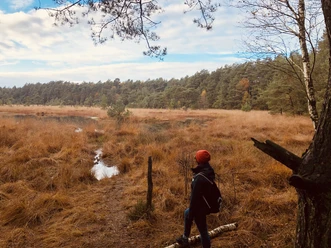
We cross the K 148 a second time and now look out over the grounds of the Huvenhoopsmoor Nature Reserve. The 1.5 km² Huvenhoopsmoor is part of the Gnarrenburg Moor. The centerpiece of the nature reserve is Lake Huvenhoop, one of the last intact raised bog lakes in Lower Saxony. Sphagnum-dominated moor grasslands, open birch forests with clearings of heather and bentgrass, re-wet peat extraction areas, and raised bog grasslands characterize this raised bog landscape and provide ideal breeding and resting conditions for numerous bird species. During bird migration, thousands of cranes, among other species, stop here in the spring and especially in the fall. Those who wish can also take a 1.6-km detour from here to the Moor Experience Trail and visit the Historic Moorhof in Augustendorf.
Those who continue the hike will next reach a parking lot and, via a nature trail, arrive at the imposing, covered Moorturm in Forstort-Anfang. It offers a fabulous view of the Huvenhoopsmoor. Especially in October and November, you have a good chance of watching hundreds of cranes fly in at dusk to their roosting grounds. It’s a natural spectacle that “gets under your skin” or “resonates in your ears,” as their trumpeting concert—alternating between “krurr” and “krarr”—is truly one-of-a-kind. From the Moorturm, the trail leads back to the parking lot. We hike along the edge of the small forest, pass the Seeholz hiking rest area , enter the shady forest, and hike to the edge of the 41-meter-high Steinberg, where sand-lime stone has been quarried since 1960. There, we turn left, walk out of the forest to the western edge of the nature reserve, and through fields and meadows to the small grove Seegen.
We walk through the small grove, cross the rewet Huvenhoopsmoor, and, after crossing the L 122, reach the Glinstedt Tournament Grounds. With a little luck, we can watch horses and riders practicing their jumps before we hike along nature trails through the cultivated Ehnblecksmoor and our NORDPFAD crosses Gravesstraße. We cross the road and walk about 600 meters along the grassy strip next to the road. Then we turn right onto the paved dirt road, hike a short distance through the drained, agriculturally used, and heath-covered Falkenbergsmoor, and finally reach the Falkenberg Rest Area, which is a great spot for a short break. At the next intersection, we turn right, follow the farm road to Falkenbergstraße, and from there walk along the grassy strip next to the busy road back to the Glinstedt Bell Tower.
Connections to other NORDPFADEN trails:
A connecting trail (7.2 km) leads from the start of the forest section to starting point 1 of the NORDPFAD Eichholz and Franzhorn.
Trail Closures
Before your hike, you should checkwww.nordpfade.de to find out about possible detours and trail disruptions that may occur due to flooding, storm damage, or forestry work, for example. Route markings
- Marker
The marker shows a white "N" on an orange background with the name of the NORDPFAD Huvenhoopsmoor.
Signposting
Destination signposts supplement the markings and are placed at prominent points. The signposts list places that are on the route or branch off from it, together with the distance in kilometers. The logo of the respective NORDPFADES is located underneath. Directions & Parking facilities
- Getting thereFrom the A1 or A27 highways, it takes about 30–45 minutes to reach the starting points, each of which has an information sign and parking available.
- Starting Point 1: 27442 Glinstedt, parking lot at the bell tower, Falkenbergstraße
- Starting Point 2: 27442 Start of the forest, parking lot at the Moorturm, Hinterm Seeholz
ParkingThere are two parking options available along the NORDPFAD. The respective starting points can also be found there.- Parking Lot 1: 27442 Glinstedt, parking lot at the bell tower, Falkenbergstraße
- Parking Lot 2: 27442 Start of the forest trail, parking lot at the Moorturm, Hinterm Seeholz
Public transportationArrival by bus- Bus stop: Glinstedt-Mitte, 100 m from starting point 1 of the NORDPFADE
- Bus route 821: runs Mon.-Fri. between Gnarrenburg and Zeven
- Bus route 845: runs Mon.-Fri. between Gnarrenburg and Glinstedt
- Info: www.vbn.de
- Starting Point 1: 27442 Glinstedt, parking lot at the bell tower, Falkenbergstraße
Additional information
- Komoot
We have compiled all 24 circular hiking trails in a separate NORDPFADE collection in the well-known outdoor app. The tours can also be found in the portal under the "Northern Heath" region.
Not yet on Komoot?
There is a free voucher code for new customers. The code is ROW and can be redeemed via "Redeem voucher" at komoot.de/g or via the link https://komoot.com/de-de/g?code=ROW. Literature
- The following brochures are available free of charge at local tourist information offices and at Brochure Order. They are also available for download there.
- NORDPFADE Tour Guide
This small brochure contains everything you need to know about the hiking region. - NORDPFADE Overview Map
This handy fold-out leaflet serves as a basic planning guide for the environmentally conscious. - NORDPFADE Hiking Pass
The stamp-free version for collectors.
- My NORDPFADE
Or: "It doesn't always have to be the Camino de Santiago!"
- NORDPFADE Tour Guide
Contact person
Touristikverband Landkreis Rotenburg (Wümme) e.V.
- Ihr Ansprechpartner für die NORDPFADE und die RegionHarburger Str. 5927356 Rotenburg (Wümme)License (master data)
Touristikverband Landkreis Rotenburg (Wümme)

Social Media
Nearby
Download GPX file