Town Hall of the Peace of Westphalia

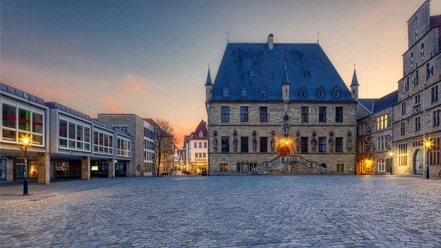
The historic city hall of Osnabrück was built between 1487 and 1512 in the late Gothic style, but already exhibits distinct Renaissance features. The front facade is dominated by an 18-meter-high hipped roof. At its lower end are a total of six towers, reminiscent of the watchtowers and corner towers of a fortress. Since 1846, a large stone staircase has provided access to the town hall; previously, it was entered via a retractable wooden staircase. Since 1963, the 500-year-old entrance door has been adorned with the “Friede” (Peace) door handle, crafted from heavy bronze by sculptor Fritz Szalinski. It depicts a dove perched on a beam bearing the inscription “Friede 1648” as well as the city coat of arms in the form of the Osnabrück Wheel. Above the entrance stands the city’s founder, the Frankish king and later Emperor Charlemagne. Flanking him since the 19th century are the eight so-called “Imperial Sculptures,” a gift from the Prussian royal family to the city of Osnabrück.
The ground floor of City Hall houses, among other things, the Peace Hall and the treasury, where the city council’s silverware, coins, minting dies, the oldest marksmen’s chain, and important documents are kept. On the upper floor stands a model of Osnabrück in the year 1633, created in the mid-1950s by the sculptor Heinrich Bohn.
On September 13, 1944, City Hall was severely damaged during an Allied bombing raid. The historic furnishings had already been moved to a safe location some time earlier and were thus saved. Reconstruction began as early as 1947 and was completed in time for the 300th anniversary of the Peace of Westphalia on October 25, 1948.
On July 5, 2019, an attack was carried out on the historic front door. However, the damage—which was only superficial—was repaired.
The then-mayor of Osnabrück, Ertwin Ertman, is believed to have been the driving force behind the project. Coming from a humble background, he had risen to power and influence. He represented Osnabrück in the Hanseatic League in Cologne, Bremen, and Lübeck. As early as 1452, he succeeded in ending the city’s expulsion from the Hanseatic League, which had been imposed two years earlier for a period of ten years. Despite social unrest, Ertman held the office of mayor of the Old Town for 23 years and served on the city council for 52 years. He did not step down from office until the year of his death in 1505.
With the construction of the New City Hall, the citizenry countered the ecclesiastical immunity of the cathedral with a self-assured center. In doing so, they symbolized their independence, economic strength, and position of political power.
Beginning in 1643, the Peace Hall became one of the two venues for the negotiations of the Peace of Westphalia (1648). Alongside Münster, the peace treaties ending the Thirty Years’ War (1618–1648) were signed here. The walls of the Peace Hall are adorned with portraits of the 42 European envoys to the peace congress, painted in 1648 by the Flemish artist Anselm van Hulle, as well as portraits of the rulers of the warring parties at the time (including Queen Christina of Sweden, Louis XIV of France, and the Holy Roman Emperor Ferdinand III). Below the portraits and windows are the carved oak pews, which combine Gothic patterns with early Renaissance motifs. The so-called “privileges shrines”—embedded in the masonry between the windows—served, among other things, as wall cabinets for Osnabrück’s major hospitals to store important documents such as foundation charters and prescriptions. They feature figurative and ornamental carvings. Citizens could rent these wall cabinets, which had simpler doors, as a kind of locker for their valuables. A 16th-century wrought-iron chandelier takes pride of place as the room’s centerpiece. Its three tiers depict Paradise, the firmament with the sun, moon, and stars, as well as the Virgin Mary with the infant Jesus and three representatives of the estates. The reindeer antlers from a 36-point stag were added later. Queen Christina of Sweden presented them to the city of Osnabrück upon the signing of the peace treaty.
The Peace of Westphalia is considered a landmark event in German and European history, as it laid the initial foundations for a united Europe. Since April 2015, the Osnabrück City Hall and the Münster City Hall have therefore been awarded the European Heritage Label. The European Commission awards this label to sites that hold special significance for European history.
The building originally served to check the weight and quality of goods (especially textiles). The products were measured, weighed, and the applicable duties were determined. After thorough inspection, the goods were stamped with a seal in the shape of the Osnabrück wagon wheel. In the Middle Ages, herbs were also stored in the attic of the City Weigh House. These herbs later formed the “Grut,” a spice mixture used to flavor beer.
An audio guidance system helps people with and without visual impairments find their way around City Hall
The app’s technology helps both blind people and those with limited mobility find the best route through City Hall. The app detects when a user enters City Hall. The user can then select from a list which room in City Hall the app should guide them to using audio cues. The user immediately receives information about their location, including which direction they are facing in the room and what is around them. The app then guides them step by step to their destination. Individual profiles can also be saved in the app. If a user indicates that they use a wheelchair, the app will only show routes that lead to their destination without requiring the use of stairs.
However, the technology can also be used for navigation within City Hall without the app. To this end, QR codes have been placed on rooms throughout City Hall—either on door signs or next to the doors. Anyone who scans them can be guided from that location to another room in City Hall.
The ground floor of City Hall houses, among other things, the Peace Hall and the treasury, where the city council’s silverware, coins, minting dies, the oldest marksmen’s chain, and important documents are kept. On the upper floor stands a model of Osnabrück in the year 1633, created in the mid-1950s by the sculptor Heinrich Bohn.
On September 13, 1944, City Hall was severely damaged during an Allied bombing raid. The historic furnishings had already been moved to a safe location some time earlier and were thus saved. Reconstruction began as early as 1947 and was completed in time for the 300th anniversary of the Peace of Westphalia on October 25, 1948.
On July 5, 2019, an attack was carried out on the historic front door. However, the damage—which was only superficial—was repaired.
Background on the Construction of City Hall
As early as 1244, an Osnabrück town hall on the market square was first mentioned in a document. It was located on the site of today’s city library and was demolished in 1836. Over the course of the 15th century, its relatively small size was no longer sufficient to meet the needs of the growing city and the diverse tasks of civic self-government. The decision to build a new town hall led to a long and arduous process. Preparations began as early as 1477, ten years before construction started. Since there was no central square in the densely built-up city, a new construction site had to be created. The cemetery of St. Mary’s Church was moved behind the church, and houses and an entire alley had to be demolished on the site of today’s town hall and market square. It was not until 1487 that the 25-year construction period of the “New Town Hall in the Old Town” began. Based on old city accounts, the estimated total cost of construction was approximately 6,000 marks. Adjusted for today’s value, the cost amounted to approximately 23 million euros. Depending on the city’s financial situation, the construction was funded from the current city budget. In 1487 and 1503, the city council levied a special tax to finance the construction. The heavy financial burden also led to uprisings.The then-mayor of Osnabrück, Ertwin Ertman, is believed to have been the driving force behind the project. Coming from a humble background, he had risen to power and influence. He represented Osnabrück in the Hanseatic League in Cologne, Bremen, and Lübeck. As early as 1452, he succeeded in ending the city’s expulsion from the Hanseatic League, which had been imposed two years earlier for a period of ten years. Despite social unrest, Ertman held the office of mayor of the Old Town for 23 years and served on the city council for 52 years. He did not step down from office until the year of his death in 1505.
With the construction of the New City Hall, the citizenry countered the ecclesiastical immunity of the cathedral with a self-assured center. In doing so, they symbolized their independence, economic strength, and position of political power.
The Peace Hall and the Peace of Westphalia
The Peace Hall was originally designed as a council chamber or meeting hall: a room with a bench running around the perimeter and a spectacular “democratic” concept—all those present could see each other’s faces during deliberations. There was no spatial hierarchy; the council itself formed the center of its decisions.Beginning in 1643, the Peace Hall became one of the two venues for the negotiations of the Peace of Westphalia (1648). Alongside Münster, the peace treaties ending the Thirty Years’ War (1618–1648) were signed here. The walls of the Peace Hall are adorned with portraits of the 42 European envoys to the peace congress, painted in 1648 by the Flemish artist Anselm van Hulle, as well as portraits of the rulers of the warring parties at the time (including Queen Christina of Sweden, Louis XIV of France, and the Holy Roman Emperor Ferdinand III). Below the portraits and windows are the carved oak pews, which combine Gothic patterns with early Renaissance motifs. The so-called “privileges shrines”—embedded in the masonry between the windows—served, among other things, as wall cabinets for Osnabrück’s major hospitals to store important documents such as foundation charters and prescriptions. They feature figurative and ornamental carvings. Citizens could rent these wall cabinets, which had simpler doors, as a kind of locker for their valuables. A 16th-century wrought-iron chandelier takes pride of place as the room’s centerpiece. Its three tiers depict Paradise, the firmament with the sun, moon, and stars, as well as the Virgin Mary with the infant Jesus and three representatives of the estates. The reindeer antlers from a 36-point stag were added later. Queen Christina of Sweden presented them to the city of Osnabrück upon the signing of the peace treaty.
The Peace of Westphalia is considered a landmark event in German and European history, as it laid the initial foundations for a united Europe. Since April 2015, the Osnabrück City Hall and the Münster City Hall have therefore been awarded the European Heritage Label. The European Commission awards this label to sites that hold special significance for European history.
The City Weigh House
The City Weigh House is located right next to City Hall. Today, it houses, among other things, the Registry Office. The building was constructed between 1531 and 1532 as a two-story, gabled structure made of limestone rubble masonry. A distinctive feature is the four-step stepped gable. In the attic, two bearded men hold the city’s coat of arms. After being destroyed during World War II, the City Weigh House was rebuilt in 1953 to serve the city administration.The building originally served to check the weight and quality of goods (especially textiles). The products were measured, weighed, and the applicable duties were determined. After thorough inspection, the goods were stamped with a seal in the shape of the Osnabrück wagon wheel. In the Middle Ages, herbs were also stored in the attic of the City Weigh House. These herbs later formed the “Grut,” a spice mixture used to flavor beer.
An audio guidance system helps people with and without visual impairments find their way around City Hall
The app’s technology helps both blind people and those with limited mobility find the best route through City Hall. The app detects when a user enters City Hall. The user can then select from a list which room in City Hall the app should guide them to using audio cues. The user immediately receives information about their location, including which direction they are facing in the room and what is around them. The app then guides them step by step to their destination. Individual profiles can also be saved in the app. If a user indicates that they use a wheelchair, the app will only show routes that lead to their destination without requiring the use of stairs.
However, the technology can also be used for navigation within City Hall without the app. To this end, QR codes have been placed on rooms throughout City Hall—either on door signs or next to the doors. Anyone who scans them can be guided from that location to another room in City Hall.


Good to know
Openings
- The town hall information desk is open Monday to Friday from 10 am to 5 pm.
The historic Osnabrück Town Hall is open for tourist visits from Monday to Friday from 10 am to 5 pm, on Saturdays from 9 am to 4 pm and on Sundays from 10 am to 4 pm. The town hall is not usually open on public holidays.
The Friedenssaal is freely accessible from Monday to Friday from 10 am to 5 pm, on Saturdays from 9 am to 4 pm and on Sundays from 10 am to 4 pm. Outside of these times, the hall remains accessible via the tried and tested tour concept, for example during night watchman tours, according to the city.Dayoff: Closed all holidays Price info
- Free admission
Other Furnishing/Equipment
Handicapped accessible WC
Barrier-free access
Certification and seal of quality - miscellaneous
Other certification
Accessibility
- General Information on Accessibility
Behindertengerechte Parkplätze: ja
Behindertengerechter Zugang: ja
Behindertengerechtes WC: ja Directions & Parking facilities
- Parken:
Stadthaus-Garage
Nikolai-Garage
Vitihof-Garage
Bushaltestellen:
Heger Tor
Theater License (master data)
Tourismusgesellschaft Osnabrücker Land mbH