St. Peter's Cathedral

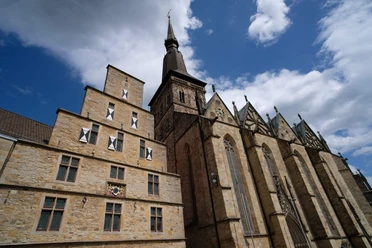
The late Romanesque St. Peter’s Cathedral, the Roman Catholic cathedral of the Diocese of Osnabrück, stands on the cathedral square. The first church was built as early as 785 by the Frankish king and later emperor, Charlemagne. Five years earlier, he had founded a mission outpost at Hasefurt, thereby laying the foundation for the city of Osnabrück. The Diocese of Osnabrück was then established around the year 800. Its current appearance is largely the result of the construction efforts of Bishop Adolf of Tecklenburg in the 13th century.
The dome vault (pointed arch vault) in the central section of the three-aisled nave is just as high as the pillars that support it. In its tied system, the cathedral comprises a total of 15 bays (spans between the columns). While the vaults of the nave are predominantly pointed and characteristic of the Gothic style, the exterior walls feature the round-arched door and window openings typical of the Romanesque period. The building is just under 100 meters long, although at first glance it does not appear to be so. Romanesque architects were aware of this and prevented the structure from appearing shorter by incorporating irregular patterns on the sides and a vault that becomes increasingly steep and higher.
The cathedral underwent later renovations in the 17th and 18th centuries, when the Gothic spires were replaced by Baroque domes. Alexander Behnes, who was responsible for the cathedral’s preservation from 1882 to 1910, carried out further additions and renovations. During the bombing of Osnabrück on September 13, 1944, the cathedral’s roof, as well as the Baroque spires and additions, were destroyed. During reconstruction, the towers were given their current pyramid-shaped roofs, which emphasize the cathedral’s Romanesque character.
The monumental triumphal cross, dating from around 1230, is particularly impressive. With a corpus height of 3.85 meters, it is the largest cross of its kind in all of Germany. Now nearly 800 years old, it is also one of the cathedral’s oldest pieces of furnishings. As was customary at the time, this oak figure of Jesus also contains a relic in its head. The feet of the figure of Jesus are each nailed to the cross with two nails. This reflects the medieval Romanesque understanding of the crucifixion scene. In the later Gothic period, both feet were generally simply crossed and held to the cross with a single nail.
The Romanesque-style bronze baptismal font (also called a “Fünte,” meaning “spring”) dates from around 1225 and was used for the ritual of full-body baptism. For this, the candidates for baptism had to be completely immersed in the font. Previously, the baptismal fonts used for this purpose were placed as far away from the altar as possible, since the candidates for baptism were not yet baptized and, as such, were to enter the church as little as possible, if at all. In addition, these fünte were heated: Outside the church, a small fire was lit, stones were placed in it, and these stones were then used to warm the basin.
The cathedral has two organs: the current main organ dates from 2003 and has 53 stops. In addition, there is a small choir organ in the northern transept.
Podcast “Domgeflüster – Secrets Beneath the Vaults” (German)
Students from the Angelaschule Osnabrück have produced six podcast episodes highlighting 2,026 unique features of the cathedral. They introduce visitors to the reliquary gallery, the grand cathedral organ, and mysterious and hidden stories from the cathedral. The project was developed in collaboration with the Cathedral Treasury and the Diocesan Museum and was funded by the German Foundation for Monument Protection.
Architectural Features
The three towers of varying sizes are particularly striking. During the Reformation, the southern tower was rebuilt in the Gothic style between 1509 and 1544 using materials from its predecessor, which had been demolished. One reason for this was the taller church towers of St. Katharinen and St. Marien. The Catholic clergy did not want the cathedral’s tower to be outdone in height. Another distinctive feature is the rose window set into the façade above the west portal, dating from the transition period between the Romanesque and Gothic styles. It allows light to enter the church building and incorporates elements of both architectural styles. Thus, from the outside it appears Gothic, while inside the cathedral it appears Romanesque.The dome vault (pointed arch vault) in the central section of the three-aisled nave is just as high as the pillars that support it. In its tied system, the cathedral comprises a total of 15 bays (spans between the columns). While the vaults of the nave are predominantly pointed and characteristic of the Gothic style, the exterior walls feature the round-arched door and window openings typical of the Romanesque period. The building is just under 100 meters long, although at first glance it does not appear to be so. Romanesque architects were aware of this and prevented the structure from appearing shorter by incorporating irregular patterns on the sides and a vault that becomes increasingly steep and higher.
The cathedral underwent later renovations in the 17th and 18th centuries, when the Gothic spires were replaced by Baroque domes. Alexander Behnes, who was responsible for the cathedral’s preservation from 1882 to 1910, carried out further additions and renovations. During the bombing of Osnabrück on September 13, 1944, the cathedral’s roof, as well as the Baroque spires and additions, were destroyed. During reconstruction, the towers were given their current pyramid-shaped roofs, which emphasize the cathedral’s Romanesque character.
Notable Features of the Cathedral
The cathedral’s historical furnishings include, among other things, the high altar and the choir stalls by the Osnabrück sculptor Heinrich Seling, dating from 1894–1905. Also of note are the 16th-century figures of the apostles on the pillars of the nave and the pulpit made of reddish-colored artificial marble from 1752, one of the few surviving examples of Rococo art.The monumental triumphal cross, dating from around 1230, is particularly impressive. With a corpus height of 3.85 meters, it is the largest cross of its kind in all of Germany. Now nearly 800 years old, it is also one of the cathedral’s oldest pieces of furnishings. As was customary at the time, this oak figure of Jesus also contains a relic in its head. The feet of the figure of Jesus are each nailed to the cross with two nails. This reflects the medieval Romanesque understanding of the crucifixion scene. In the later Gothic period, both feet were generally simply crossed and held to the cross with a single nail.
The Romanesque-style bronze baptismal font (also called a “Fünte,” meaning “spring”) dates from around 1225 and was used for the ritual of full-body baptism. For this, the candidates for baptism had to be completely immersed in the font. Previously, the baptismal fonts used for this purpose were placed as far away from the altar as possible, since the candidates for baptism were not yet baptized and, as such, were to enter the church as little as possible, if at all. In addition, these fünte were heated: Outside the church, a small fire was lit, stones were placed in it, and these stones were then used to warm the basin.
The cathedral has two organs: the current main organ dates from 2003 and has 53 stops. In addition, there is a small choir organ in the northern transept.
The Diocesan Museum
Right next to the cathedral, covering 500 square meters of exhibition space, is the Cathedral Treasury and Diocesan Museum, founded in 1918. A permanent exhibition here showcases artifacts spanning over 1,000 years of the diocese’s history. In addition to the cathedral treasury, these include the relics of the diocese’s patron saints, Crispin and Crispinian, as well as paintings, prints, sculptures, liturgical vestments, and precious furnishings. Particularly significant pieces include works by the “Master of Osnabrück” and the 11th-century silk priestly vestment of Benno II of Osnabrück.Podcast “Domgeflüster – Secrets Beneath the Vaults” (German)
Students from the Angelaschule Osnabrück have produced six podcast episodes highlighting 2,026 unique features of the cathedral. They introduce visitors to the reliquary gallery, the grand cathedral organ, and mysterious and hidden stories from the cathedral. The project was developed in collaboration with the Cathedral Treasury and the Diocesan Museum and was funded by the German Foundation for Monument Protection.


Good to know
Openings
- Mondays to Fridays: 6.30 a.m. - 7.45 p.m.
Saturdays: 7.30 a.m. - approx. 7 p.m.
Sundays: 7.30 a.m. - 8 p.m. Price info
- Viewing free of charge
Contact person
Pfarrbüro Dom St. Petrus
Ms. Marita MoroGroße Domsfreiheit 249074 OsnabrückLicense (master data)
Tourismusgesellschaft Osnabrücker Land mbH