Einbeck beer barrel path - Barrel 6: Of ice-cold brewing processes and unusual goods

Welcome to the Einbeck Beer Trail. We’re glad you’re setting out to discover our delicious beer! Follow the “Fass-Spur” through Einbeck!
Information about Keg 6:
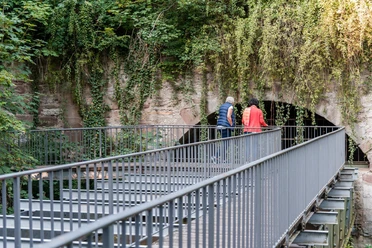
You’ve now arrived at the Krähengraben. The ramparts continue here. But how are the ramparts and moats connected to Einbeck’s beer?
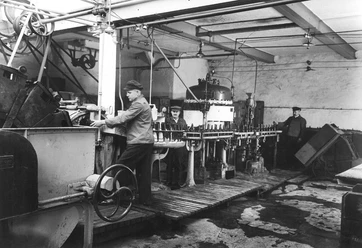
Very closely, in fact! They were once filled with water. The water served as the city’s water supply . But that’s not all: Until the invention of electric refrigeration in the 20th century, it was also needed for cooling during beer production—for example, during fermentation. The colder the process, the higher the beer’s alcohol content. That’s why brewing also took place during the winter months, from September through April. During that time, blocks of ice could easily be chiseled out of the city moats and stored in ice cellars. Their entrances can still be seen today in the rampart at Krähengraben and along the Mühlenkanal (near Fass 7).
But what if the winter was too mild? Then, as in February 1884, for example, ice was brought to our city from colder regions in the Harz Mountains. It was transported to Einbeck by freight trains. That year, 35 railcars carrying a total of 1.8 metric tons of ice had to be delivered at great expense. Even the newspaper reported on the ice shortage, calling it the “Eiscalamitet”! I wonder if Ainpöck beer was also a bit more expensive that season than in colder years?
Now continue your walk along the ramparts, looking to your left toward the city wall. There, you’ll first see the back of the Einbeck Brewery. A few meters further on, you’ll discover a street art spot in the second row depicting the story of Till Eulenspiegel. Right behind it stands the Storchenturm.
The tour continues along the ramparts to Barrel No. 7.
Would you like to experience the ramparts in a different light?
Then book our evening city tour “Light Beer and Dark Shadows” here.
Information about Keg 6:
You’ve now arrived at the Krähengraben. The ramparts continue here. But how are the ramparts and moats connected to Einbeck’s beer?
Very closely, in fact! They were once filled with water. The water served as the city’s water supply . But that’s not all: Until the invention of electric refrigeration in the 20th century, it was also needed for cooling during beer production—for example, during fermentation. The colder the process, the higher the beer’s alcohol content. That’s why brewing also took place during the winter months, from September through April. During that time, blocks of ice could easily be chiseled out of the city moats and stored in ice cellars. Their entrances can still be seen today in the rampart at Krähengraben and along the Mühlenkanal (near Fass 7).
But what if the winter was too mild? Then, as in February 1884, for example, ice was brought to our city from colder regions in the Harz Mountains. It was transported to Einbeck by freight trains. That year, 35 railcars carrying a total of 1.8 metric tons of ice had to be delivered at great expense. Even the newspaper reported on the ice shortage, calling it the “Eiscalamitet”! I wonder if Ainpöck beer was also a bit more expensive that season than in colder years?
Now continue your walk along the ramparts, looking to your left toward the city wall. There, you’ll first see the back of the Einbeck Brewery. A few meters further on, you’ll discover a street art spot in the second row depicting the story of Till Eulenspiegel. Right behind it stands the Storchenturm.
The tour continues along the ramparts to Barrel No. 7.
Would you like to experience the ramparts in a different light?
Then book our evening city tour “Light Beer and Dark Shadows” here.


Good to know
Openings
- Can be visited at any time.
Eligibility
for Groups
for Class
for familys
for individual guests
Pet allowed
Suitable for the Elderly
Suitable for Pushchair
for Children of the age of 3-6
for Children of the age of 6-10
for Children of the age of 10 upwards
Linguistic proficiency
- German, English
Other Furnishing/Equipment
Barrier-free access
Payment methods
- free of charge
Directions & Parking facilities
- Der Krähengraben in Einbeck befindet sich zwischen den Straßen Hullerser Straße und Benser Straße. Am Krähengraben Nähe Benser Straße befindet sich zusätzlich der Spielplatz.
Zu Fuß:
Ab dem Marktplatz ist die Wallanlage Krähengraben über die Marktstraße und Benser Straße in 9 Minuten (650 m) zu erreichen.
Mit dem Auto:
Ab einer der Abfahrten von der B3 nach Einbeck sind es bis zum Krähengraben rund 5 Minuten Fahrzeit (3 - 4 km). Nahegelegene Parkplätze befinden sich in der Hullerser Mauer, dem Parkhaus zum Brauhaus und in der Straße Reinserturmweg.
Mit dem ÖPNV
Den Krähengraben erreicht man vom Bahnhof Einbeck Mitte innerhalb von ca. 16 min zu Fuß (1,2 km). License (master data)
Einbeck Tourismus