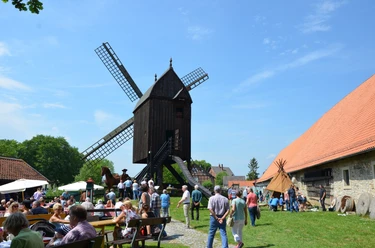
Salzgitter im Mittelalter

From this event onwards, local and regional medieval events in and around Salzgitter are presented. Manor houses and castles show the manorial structures of the time. Life in the countryside in the fifty or so villages of the Salzgitter region was characterized by agriculture and crafts.
With the integration of the Salzgitter region into the Frankish empire, Christianity was introduced. Christianization took place from Fulda Monastery via its Brunshausen branch monastery near Gandersheim and via Corvey Monastery. Numerous property deeds to churches and monasteries since the 8th/9th century prove this. There were three monasteries in the city of Salzgitter: in Ringelheim (941*), in Steterburg (1001*) and in Engerode (1235*).
In the south of Salzgitter, the salt village "Solte to gittere" developed in the High Middle Ages. Several salt springs came to the surface in the Warnetal valley. The farmers from the surrounding villages of Gitter, Vöppstedt and Kniestedt extracted the "white gold". There were 49 salt pans in which salt was boiled. The settlement that grew up around the salt springs was relatively small. A rampart and moats protected the village.


Good to know
General information
Cloakroom
Eligibility
Bad Weather Offer
Suitable for any Weather
Target Group Adult
Target Group Family
Target Group the Elderly
for Children of the age of 3-6
for Children of the age of 6-10
for Groups
for Class
for familys
for individual guests
Foreign Language
- German
Directions & Parking facilities
- Über die A39, Abfahrt Salzgitter-Lebenstedt SÜD, dann in den Stadtteil Salder einfahren und gleich die erste Straße rechts (Museumstraße) nehmen.Parking
Number of parking spaces 20 Handicapped parking spaces 6 Bus parking spaces 1 Social Media
Price info
free of charge
Eintritt freiContact person
Städtisches Museum Schloss Salder, Museumsleiter Arne Homann
Museumstraße 3438229 Salzgitter - SalderLicense (master data)
Tourist-Information Salzgitter