Historischer Markt

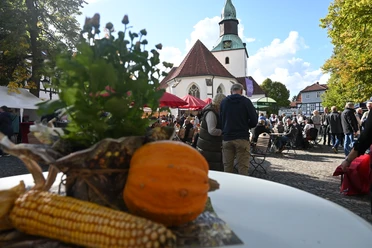
"The abundance of lovingly decorated market stalls delights and surprises us every time! For many years now, the market has been a special event for Bad Essen with a strong tourist appeal," explains Robert Wellmann, who has been the market master for 28 years now. "Delicious jam or fresh buttermilk and cheese, the 'Furzlaib' and onion bread from the stone oven, hearty ham and homemade sausage - there's something tasty for everyone." The volunteer-run juice store, which has been there almost from the start and sells bowls for a good cause, is also very popular.
But it's not just about food and drink, says Wellmann - historical garments and cloths such as historical blueprinting attract visitors, as do fragrant soaps, jewelry and traditional crafts such as basket weaving, clog and stick making, pottery and blacksmithing. Other demonstrations of historical crafts such as glass blowing, lace making, spinning and cigar making fascinate visitors. One or more barrel organs are also part of the program. The entire historic town center with the most beautiful half-timbered church square in northern Germany is now the scene of the colorful hustle and bustle.
Information about the market and its history:
The Historical Market was first held in 1975 to mark the 900th anniversary of (Bad) Essen. At that time, the events of the anniversary year were also intended to strengthen the identity of the still young municipality (founded with the territorial reform in 1972) and the sense of togetherness of the citizens in the 17 villages. In the first year, there were only six stalls on the church square. In 1997, when Robert Wellmann took over the market, there were already 88 exhibitors and the program took place on two stages. Traditionally, the market was always held on Fridays and Saturdays. Sunday was added in 2003 and the number of exhibitors rose to more than 150 by 2019. The market area expanded to include the Catholic church and a third stage location was added. As a result of the coronavirus years, the number of exhibitors fell by around a third, but has now risen again to around 140.
The Historical Market is now one of the largest and most important events in the district of Osnabrück. "Historical" here means the period between 1850 and around 1920 - a truly unique selling point. For the municipality of Bad Essen, the Historical Market is the image event par excellence and an important date in the annual calendar. The integrative idea of bringing the localities and citizens together and thus having a community-building effect for Bad Essen has been fulfilled. The traditional meeting point on Sunday morning on Bad Essen's church square: the Low German ecumenical church service with its own hymnal "op Platt" begins at 10:30 am. The Minden Museum Railway will run from Preußisch-Oldendorf via Bad Essen to Bohmte and back every two hours on Saturday and Sunday on the occasion of the Historical Market.
(Timetable at www.kleinbahnmuseum.de and www.museumseisenbahn-minden.de)
There is no entrance fee for the Historical Market.

Good to know
Price info
free of charge
License (master data)
Tourismusgesellschaft Osnabrücker Land mbH