NORDPFAD Kempowski's idyll

- 4:00 h
- 11.60 km
- 39 m
- 35 m
- 29 m
- 55 m
- 26 m
- Start: 27404 Nartum, parking lot at the Nartum cemetery, Raiffeisenstraße (starting point 1)
- Destination: 27404 Nartum, parking lot at the Nartum cemetery, Raiffeisenstraße (starting point 1)
The NORDPFAD invites you to explore the Steinfelder Forest, the Stellingsmoor, and the village of Nartum—home to 750 residents—surrounded by fields and meadows. Walter Kempowski, a prominent 20th-century German writer, lived here for 42 years.
Good to know
Pavements
- Asphalt (100%)
Best to visit
- suitableDepends on weather
Directions
- Since February 2021, we’ve been starting our loop hike at the Nartum Cemetery, where the grave of Walter Kempowski—after whom this trail is named—is also located. There are plenty of parking spaces available there, and an information sign provides details about the route.
Before we set out, we’ll visit the Nartum Megalithic Tomb, located to the left of the cemetery. It consists of a well-preserved burial chamber five meters long. We then walk past the chapel and the cemetery to the first intersection, where there is a herb bed belonging to the “Nartumer Kräuter-Runde.” Many of the lovingly tended, fragrant flower beds are located right along our NORDPFAD trail. We continue straight ahead through the fields toward the Röhrbergeiche.
Once we arrive at this natural monument, the shaded rest area on the 43-meter-high Röhrberg offers a wonderful view of the surrounding fields and meadows of Nartum. A little later, we enter the cool forest area known as Steinfelder Holz. Through the dense mixed forest, past the parking lot at Starting Point 2, the trail leads to Steinfelder Megalithic Tomb. Unlike other megalithic tombs, the burial chamber—built from massive boulders—runs north to south. The rest area here is the perfect spot to take a break.
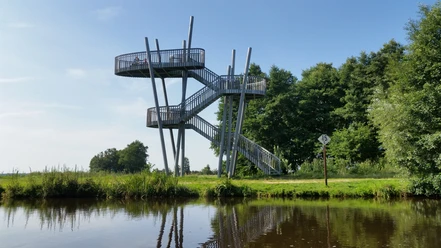
After another 600 m, we leave the dense forest. We hike along the edge of the forest on nature trails. Along the way, a pile of field stones invites us to build cairns. A wide gravel path leads to the Hemelsmoor Nature Reserve through a birch-pine forest. Our next destination is theSandkuhle Steinfelder Holz, from whose ridge there is a spectacular view down into the depths of the former sand quarry. The hill is a great spot to take a break before continuing along the edge of theStellingsmoores. The highlight of this section is the “Utkiek” viewpoint, which offers a sweeping view of the moorland that was only rewet in 2021.
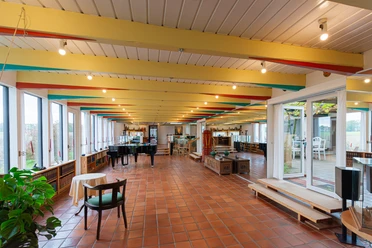
Following small drainage ditches with numerous views of the moorland and passing through marshy grasslands, we finally approach the fields and meadows of Nartum. In Nartum, a detour onto the street “Zum Röhrberg” leads toHaus Kreienhoop,—the home and workplace of the late writer and the current headquarters of the Kempowski Foundation.
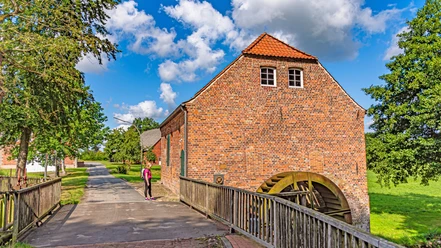
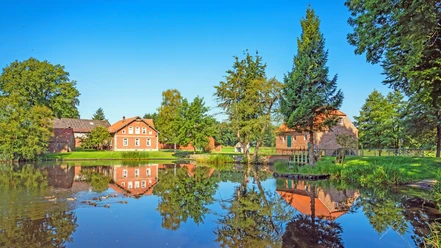
From the intersection, it’s only 600 m to Nartum Motor Mill. Together with the bakery and the clearing under the oak trees, it forms the center of the village of Nartum. From there, it’s not far to the starting point at the cemetery.
Trail Closures
Before your hike, you should checkwww.nordpfade.de to find out about possible detours and trail disruptions that may occur due to flooding, storm damage, or forestry work, for example. Route markings
- Marker
The marker shows a white "N" on an orange background with the name of the NORDPFAD Kempowskis Idylle.
Signposting
Destination signposts supplement the markings and are placed at prominent points. The signposts list places that are on the route or branch off from it, together with the distance in kilometers. The logo of the respective NORDPFADES is located underneath. Directions & Parking facilities
- Getting thereFrom the A1 highway, it takes about 10–15 minutes to reach the starting points, each of which has an information sign and parking available.
- Starting Point 1: 27404 Nartum, Nartum Cemetery, Raiffeisenstraße, approx. 200 m from the NORDPFAD
- Starting Point 2: 27412 Steinfeld, Steinfelder Holz, Am Walde
ParkingThere are two parking areas available along the NORDPFAD. The respective starting points are also located there.- Parking Lot 1: 27404 Nartum, Nartum Cemetery, Raiffeisenstraße, approx. 200 m from the NORDPFAD
- Parking Lot 2: 27412 Steinfeld, Steinfelder Holz, Am Walde
Public transportationArrival by train
Bus stop: Nartum - Am Brink, about 600 m from starting point 1 of the NORDPFAD, near the Nartum motor mill
Bus route 864: runs Mon.-Fri. between Zeven bus station and Nartum
Info: www.vbn.de Additional information
- Komoot
We have compiled all 24 circular hiking trails in a separate NORDPFADE collection in the well-known outdoor app. The tours can also be found in the portal under the "Northern Heath" region.
Not yet on Komoot?
There is a free voucher code for new customers. The code is ROW and can be redeemed via "Redeem voucher" at komoot.de/g or via the link https://komoot.com/de-de/g?code=ROW. More information
- Starting point 1 has been relocated from the former Melkhus at Hof Intemann, Mulmshorner Str. 10 in 27404 Nartum to the Nartum cemetery in Raiffeisenstraße. The reason for the relocation is the strong increase in hiking interest and the resulting increased use of the parking lot, which is privately owned."
Literature
- The following brochures are available free of charge at local tourist information offices and at Order Brochures". They are also available for download there.
- NORDPFADE Tour Guide
This small brochure contains everything you need to know about the hiking region. - NORDPFADE Overview Map
This handy fold-out leaflet serves as a compact planning guide for the environmentally conscious. - NORDPFADE Hiking Pass
The stamp-free version for collectors.
- My NORDPFADE
Or: "It doesn't always have to be the Camino de Santiago!"
- NORDPFADE Tour Guide
Contact person
Touristikverband Landkreis Rotenburg (Wümme) e.V.
- Ihr Ansprechpartner für die NORDPFADE und die RegionHarburger Str. 5927356 Rotenburg (Wümme)License (master data)
Touristikverband Landkreis Rotenburg (Wümme)

Author´s Tip / Recommendation of the author
Who was Walter Kempowski, the namesake of this NORDPFAD?
Source: www.ndr.de/geschichte/koepfe/Walter-Kempowski-Ein-literarischer-Chronist,walterkempowski101.html
A Literary Chronicler
For decades, Walter Kempowski has been one of the most widely read contemporary German authors and is regarded as one of the great literary chroniclers of 20th-century German history. The writer, who passed away in 2007 and was an honorary citizen of the city of Rostock, became best known for his ten-volume work “Echolot,” which weaves together diary entries, letters, and other documents from the time of World War II into a collage.
From Village Schoolteacher to Author
Kempowski was born in Rostock on April 29, 1929, the son of a shipowner. Three years after the end of the war, he was arrested on charges of alleged industrial espionage and served eight years in the GDR prison in Bautzen. In the mid-1950s, he moved to the West, studied education in Göttingen, and worked for 20 years as a village schoolteacher in Lower Saxony in the district of Rotenburg (Wümme) in Nartum and Breddorf before devoting himself entirely to writing.
His best-known works include, among others, *Tadellöser & Wolff*, *Uns geht’s ja noch gold. Roman einer Familie*, and *Deutsche Chronik*. He also received great acclaim abroad for his monumental work “Echolot.” His last book, “Alles umsonst,” was published in 2006. The novel tells the story of the dramatic escape of Germans during the winter of 1945 from East Prussia, which was occupied by the Red Army.
Diaries as the Most Important Sources
In his works, the author repeatedly addressed the theme of totalitarian violence and ideology. In doing so, he incorporated numerous elements of his own biography—from his time in the Third Reich through the turmoil of the war and his escape, all the way to his conviction and imprisonment for espionage by the Soviet occupiers in postwar Germany.
The most important source for Kempowski’s work was diaries: his own, which he had kept since 1945, but also the writings of others, which he had been collecting since the 1980s. Many of his reviewers regarded Kempowski as representative of an entire generation of the postwar German middle class.
Numerous awards
Kempowski had to wait a long time for widespread recognition—for the avowed anti-communist, the commercial success of his nine “Chronicle” novels did not necessarily bring him the corresponding literary acclaim right away. That changed fundamentally only with the publication of the “Echolot” war chronology in the 1990s. Numerous honors followed.
Among other awards, Kempowski received the Hans-Erich-Nossack Prize for his life’s work in Rostock in October 2005. Other awards include the Konrad Adenauer Foundation Literature Prize (1994), the Federal Cross of Merit (1996), and the Order of Merit of the State of Lower Saxony (2004). In 2005, he received the Thomas Mann Prize.
The Academy of Arts in Berlin, which had taken over the writer’s archive in 2005, exhibited his personal collection that year under the title “Kempowski’s Life Stories.” Due to his illness, the writer was unable to see the exhibition himself. According to his wife, Hildgard Kempowski, who passed away in 2019, this exhibition was, however, the “highlight of his life.” “The significance you attach to my work has surprised me, and the love and care that went into realizing this exhibition makes up for a great deal,” Kempowski explained in a message of greeting that his son Karl Friedrich read aloud at the opening. In 1994, Kempowski’s hometown of Rostock had awarded him honorary citizenship.Social Media
Nearby
Download GPX file