Heimatmuseum Scheeßel
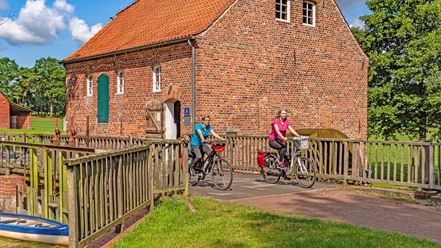
The Scheeßel Local History Museum, founded in 1913, now consists of two farmsteads located about 300 meters apart, with a total of 13 historic half-timbered buildings.
At the Meyerhof, in the center of Scheeßel, traditional crafts are demonstrated. A permanent exhibition documents traditional hand-indigo printing, which has been recognized by UNESCO as an Intangible Cultural Heritage of Humanity since 2018. The volunteer-run indigo-printing workshop can be visited as part of guided tours. The Weberhaus houses twelve historic farm looms. Hand weaving, which has been on the national list of Intangible Cultural Heritage since 2024, is taught here in classes. The Kunstgewerbehaus, built in 1908, hosts up to five special exhibitions each year featuring art, cultural history, and regional history. A blacksmith’s shop and a tenant farmer’s house complete the complex.
On the grounds of the Heimathaus, approximately 300 meters away, the 19th-century rural living and working environment is documented. This compact open-air museum features a small-scale farmstead and outbuildings dating from 1830, including the typical structures such as a barn, stable, granary, and bakehouse. A permanent exhibition on local history can be viewed on the upper floor of the Heimathaus.
Events
Museum Day featuring traditional crafts and market stalls (May 1), arts and crafts market (late November), educational programs for school groups, permanent indigo printing exhibition, special exhibitions, weaving courses, spinning courses, lectures, bike tours, guided tours in High German, Low German, and English—and, upon request, in Scheeßel traditional costume—as well as school vacation programs.
At the Meyerhof, in the center of Scheeßel, traditional crafts are demonstrated. A permanent exhibition documents traditional hand-indigo printing, which has been recognized by UNESCO as an Intangible Cultural Heritage of Humanity since 2018. The volunteer-run indigo-printing workshop can be visited as part of guided tours. The Weberhaus houses twelve historic farm looms. Hand weaving, which has been on the national list of Intangible Cultural Heritage since 2024, is taught here in classes. The Kunstgewerbehaus, built in 1908, hosts up to five special exhibitions each year featuring art, cultural history, and regional history. A blacksmith’s shop and a tenant farmer’s house complete the complex.
On the grounds of the Heimathaus, approximately 300 meters away, the 19th-century rural living and working environment is documented. This compact open-air museum features a small-scale farmstead and outbuildings dating from 1830, including the typical structures such as a barn, stable, granary, and bakehouse. A permanent exhibition on local history can be viewed on the upper floor of the Heimathaus.
Events
Museum Day featuring traditional crafts and market stalls (May 1), arts and crafts market (late November), educational programs for school groups, permanent indigo printing exhibition, special exhibitions, weaving courses, spinning courses, lectures, bike tours, guided tours in High German, Low German, and English—and, upon request, in Scheeßel traditional costume—as well as school vacation programs.
Good to know
Openings
- Meyerhof:
The exhibitions are open Tuesday through Friday from 9:00 a.m. to 12:00 p.m. and on Tuesdays and Fridays from 2:00 p.m. to 5:00 p.m. From April through October, the museum is also open on Saturdays, Sundays, and holidays from 11:00 a.m. to 5:00 p.m. The outdoor grounds are accessible year-round.
Heimathaus:
The Heimathaus on Zevener Straße is open from May through September on Saturdays, Sundays, and holidays from 11:00 a.m. to 5:00 p.m. The outdoor grounds are accessible year-round.Dayoff: Monday Price info
- Admission is free. Guided tours cost 3.50 euros per person.
Eligibility
Bad Weather Offer
Suitable for any weather
for Groups
for Class
for familys
for individual guests
Suitable for the Elderly
for Children of all Ages
Linguistic proficiency
- German, English
Other Furnishing/Equipment
Toilet
Baby Change
Payment methods
- free of charge, Cash payment on site
Certification and seal of quality - miscellaneous
Other certification
Accessibility
- General Information on AccessibilityDue to the predominantly historic architecture and the historic surroundings (cobblestone streets, etc.), accessibility is limited. The exhibitions are accessible via ramps. There is an accessible restroom at the Meyerhof.
Directions & Parking facilities
- Scheeßel liegt zentral im Elbe-Weser-Dreieck und ist von den Großstädten Bremen, Hamburg und Hannover aus gut zu erreichen. Das Museum befindet sich zentral im Ort.
Mit dem PKW:
Sie erreichen Scheeßel von Bremen oder Hamburg aus über die A1, Abfahrt Elsdorf (dann die L 131 Richtung Scheeßel) oder Abfahrt Sittensen (dann die L 130 über Helvesiek Richtung Scheeßel). Das Museum ist an der B 75, die durch Scheeßel führt, ausgeschildert.
Mit öffentlichen Verkehrsmitteln:
Scheeßel ist gut per Bahn erreichbar. Der Bahnhof ist etwa 1,5 km vom Museum entfernt und ist zu Fuß oder mit dem Bürgerbus zu erreichen. Die Bahngesellschaft "metronom" bietet mit dem "metronom regio" eine direkte Verbindung zwischen Hamburg und Bremen an, in der auch eine Fahrradmitnahme möglich ist. Weitere Infos zu den Bahn- und Busverbindungen finden Sie unter www.bahn.de, www.vnn.de und www.vbn.de. Social Media
More information
- Combine a visit to the museum with a hike along the NORDPFAD Wümme and Vareler Heide trail. The loop trail starts right at the Meyerhof. Another interesting option is the Blueprint Tour, a guided walk through the town with informational stops. The brochure with details is available at the museum.
Contact person
Heimatmuseum Scheeeßel
Mr. Dr. Matthias LoeberAm Meyerhof 127383 ScheeßelLicense (master data)
Heimatverein "Niedersachsen" e.V. Scheeßel