Open Monument Day
On Sunday, September 13, 2026, the city of Hann. Münden will participate in the nationwide Open Monument Day®. Under this year’s theme, “NetzWERKE: Monuments & Infrastructure,” historic buildings, technical monuments, and special cultural sites will open their doors.
Twelve event venues, along with three additional guided tours, will highlight how transportation routes, trade, religion, public services, crafts, and social networks have shaped the development of Hann. Münden and its neighborhoods. Guided tours, lectures, exhibitions, and hands-on activities will offer fascinating insights into the history of these monuments.
Opening Ceremony at Doktorwerder
At 10:00 a.m., Mayor Tobias Dannenberg will open Open Monument Day at Doktorwerder. Following this, a representative from the Weser Waterways and Shipping Administration will speak to mark the anniversary “150 Years of Unified Waterways Administration.”
Around 10:30 a.m., City Archivist Stefan Schäfer will explain the historical significance of Doktorwerder in his lecture “Doktorwerder—More Than Just an Island.”
1. Doktorwerder
Hours: 10:00 a.m. to 5:00 p.m.
On Doktorwerder, visitors can tour the historic Borkenhäuschen, the Werra Lock, and the historic needle weir.
The Borkenhäuschen was built in 1798 by merchant Friedrich Carl Wilhelm Freitag as a chapel for his Catholic wife. The building, clad in tree bark, was the first Catholic place of worship in Hann. Münden after the Reformation. Today, it is maintained by the Weser Waterways and Shipping Authority and used as part of waterway maintenance operations.
The Werra Lock, built in 1881, has a usable length of 49 meters and a width of 7.30 meters. Together with the needle weir, it stands as a testament to historic hydraulic engineering.
The needle weir dates from 1877 and serves to regulate the water level. To this day, the individual wooden needles allow for flexible, manual control without mechanical or electrical technology. Setting up and positioning the trestles, as well as inserting and removing the needles, are still done by hand.
Information panels, on-display trestles and needles, and a series of photographs illustrate the construction and installation of the weir. Staff from the Weser Waterways and Shipping Authority are available to answer questions.
Refreshments and seating are available. Coloring books and craft sheets are provided for children ages three to ten.
2. Half-timbered House at Lange Straße 5
Opening hours: 11:00 a.m. to 4:00 p.m.
Address: Lange Straße 5
This three-story half-timbered house, featuring cantilevered upper stories and a dormer, was built between the mid- and late 17th century. It is distinguished by decorative elements typical of its era and the ornate bracing of the upper-story balustrades.
Under the title “The City Living Room,” guided tours of the building lasting approximately 45 minutes will be offered at 11:30 a.m., 1:00 p.m., and 2:30 p.m. The number of participants is limited to ten people per tour.
Throughout the opening hours, a painting activity for children ages five and up will take place on the ground floor. Participation is only permitted when accompanied by an adult. Cold beverages will be available.
3. Steinbrücken Quarter
Hours: 11:00 a.m. to 5:00 p.m.
Location: Untere Lange Straße and Sydekumstraße
The Steinbrückenquartier is a typical old town neighborhood with half-timbered block-edge development located in the immediate vicinity of the historic Steinbrücke bridge over the Werra River. This is where the border between the castle’s free territory and the town once ran. The Steinwerk, built around 1250, is also the oldest building in Hann. Münden.
Retailers, restaurant owners, and property owners have joined forces to beautify and revitalize the neighborhood through joint activities. The Steinbrückenquartier flags serve as a visible symbol of this network.
Visitors can stroll through the neighborhood and discover small shops, arts and crafts studios, and cafés. Information about the Steinbrückenquartier is available at “Fette Typen,” “Atelier AF Kunst & Wohnen,” and the “Kleine Rösterei.”
4. Mosque of the Turkish-Islamic Community of Hann. Münden, Inc.
Hours: 11:00 a.m. to 4:00 p.m.
Address: Sydekumstraße 3
In 1783, innkeeper Georg Ludwig Rosenbach had three buildings on the city wall demolished and the “Neues Sydekum” hotel built in their place. The imposing, eleven-bay building continues to dominate the riverfront view to this day. In the mid-19th century, it became the headquarters of the Sydekum Social Club and was expanded to include a two-story ballroom. From 1920 to 2000, the Evangelical Methodist congregation used the building as a church. It was subsequently converted into a Muslim community center by the Turkish community.
Today, the mosque serves as a religious and social gathering place and is an integral part of the city’s cultural network.
Guided tours lasting about 30 minutes begin at 11:30 a.m., 1:00 p.m., and 2:30 p.m. The tour covers the prayer hall, the ablution facilities used before prayer, the cafeteria for Quran students and small events, as well as other functional rooms. The number of participants is limited to 15 to 20 people per tour. The tours are also suitable for children ages eight and up when accompanied by an adult.
The entrance area is at ground level. The other rooms on the first through third floors are accessible only by stairs. Appropriate attire is requested. The prayer rooms on the first floor may only be entered without outdoor shoes. Slippers or socks are recommended; entering barefoot is not permitted. There are no chairs available in the prayer room, but visitors may sit on the carpet.
Turkish baked goods, desserts, tea, and cold beverages are available.
5. Welfenschloss
Hours: 11:00 a.m. to 4:00 p.m.
Meeting point: Schlossplatz, museum entrance
In 1501, Duke Erich I began expanding the medieval castle into the residential palace of the Guelph dukes. After a fire in 1560, the palace was rebuilt starting in 1561 in the Weser Renaissance style. In the meantime, it served as a barracks, a grain storehouse, and a warehouse. Today, it houses, among other things, the district court, the tax office, the City Museum, the city archives, the city library, and parts of the city administration.
Guided tours of the Lepanto Hall, each lasting about 30 minutes, take place at 12:00 p.m., 1:00 p.m., and 2:00 p.m. The tour highlights the Ship’s Chamber with its mural “The Battle of Lepanto” as well as the historic staircase. Tour guides Dagmar Bartoschek and Elfie Berg will welcome participants in the ground-floor foyer at the museum entrance. A maximum of 20 people may participate per tour. The tours are also suitable for children.
At 3:00 p.m., City Archivist Stefan Schäfer will give a lecture at the museum titled “On the Trail of a Legionary” about the traces of the Romans in Hedemünden.
The permanent exhibition presents the results of excavations and research on the Roman military camp, which was only discovered in 2003. More than 200 artifacts provide insights into life in the Roman camp.
Note: There is currently a construction site on Schlossplatz.
6. Evangelical Reformed Half-Timbered Church
Hours: 11:00 a.m. to 3:00 p.m.
Address: Burgstraße 8
From the outside, the building looks like an ordinary townhouse. Inside, however, is a church interior that makes the Evangelical Reformed Church a unique historical monument in southern Lower Saxony.
The church interior, originally designed in the Baroque style in 1710, later influenced by Classicism, and modernized around 1980, bridges different eras. At the same time, the Evangelical Reformed Church, with its synodal union of several congregations, serves as a model for a church network.
The church is open to visitors. Staff members will be on site to answer any questions.
The Sunday service begins at 10:00 a.m.
7. Forest Botanical Garden (Natural Monument)
Hours: 10:00 a.m. to 5:00 p.m.
Address: Mitscherlichstraße 5
Shortly after the Forestry Academy was founded in 1868, the Forest Botanical Garden was established for educational and research purposes. Within a short time, it developed into one of the most important forestry botanical gardens in northern Germany. Despite later losses of land, it still features numerous tree and shrub species from many countries, particularly from the Northern Hemisphere.
As a historic garden monument, the Forest Botanical Garden is an integral part of Hann. Münden’s green network and educational infrastructure. It serves as a teaching and demonstration site for kindergartens, schools, vocational training institutions, universities, dendrologists, and interested citizens.
Guided tours lasting approximately 60 minutes begin at 10:30 a.m. and 3:30 p.m., titled “New Discoveries Among Ancient Giant Trees in the Over 150-Year-Old Natural Monument: The Forest Botanical Garden.”
The tour follows level paths through the garden, highlighting century-old giant trees, shrubs with colorful fruits, and autumn crocuses. Participants will also learn interesting facts about Hann. Münden’s forestry tradition as well as the origin, use, and care of the trees and shrubs.
The meeting point is the entrance area of the Forest Botanical Garden. The tours are also suitable for children. The event is organized by the Friends of the Hann. Münden Forest Botanical Garden Association (Förderverein Forstbotanischer Garten Hann. Münden e. V.).
The Modellbauclub Münden e. V. will be offering drinks, grilled sausages, and cake in the entrance area. Seating is available.
8. Fährenpfortenturm – Hagelturm
Hours: 10:00 a.m. to 5:00 p.m.
Address: Fuldabrückenstraße 24
The horseshoe-shaped city wall tower was built in the 14th century. In 1849, it was raised from 25 to 42 meters to allow for the production of shot pellets using the tower casting method. Since 2000, the former production facility has been converted into the Museum of Work. Following extensive renovation, it reopened in 2023.
The supply of shot balls to regions beyond the city made the tower an important part of earlier trade and supply networks. As part of the medieval city fortifications, it also secured the road network of the time.
Visiting the museum and climbing the tower are free of charge. The tower offers a breathtaking view of the city and the river landscape. At any given time, a maximum of 20 people are allowed in the tower. Members of the City Guides Guild explain the historical process of shot production and answer questions.
A roughly 15-minute documentary film, suitable for children as well, shows the production of shot balls. Approximately 25 seats are available for the screening.
Due to the limited number of visitors, there may be wait times for the tower tour.
The Mündener Altstadt e. V. Friends Association offers soft drinks, coffee, and freshly baked waffles.
9. Packhof
Hours: 11:00 a.m. to 5:00 p.m.
Address: Lohstraße 17
This Neoclassical warehouse was built in 1839 and 1840 and has been largely preserved in its original condition. At the time of its design, great hopes were pinned on inland waterway shipping. However, with the expansion of the railroad beginning in 1856, this mode of transport gradually lost its importance. Navigation on the Werra River came to a halt as early as 1873, so the Packhof served its original purpose only until 1880. Afterward, the building stood largely empty. Since 1992, it has been used primarily for events during the summer months.
The Packhof is located at the confluence of the Werra and Fulda rivers and symbolizes the trade of goods by water, to which Hann. Münden owes a significant part of its historical significance and prosperity.
The ground floor is open to visitors. The Förderverein Mündener Altstadt e. V. offers coffee and cake.
10. Masonic Lodge and Lodge House
Hours: 11:00 a.m. to 5:00 p.m.
Address: Bremer Schlagd 16
This extraordinary half-timbered house was built in 1729 as an inn on the site of a former 16th-century city wall bastion. From 1808 onward, it served as a clubhouse, and from 1856 to 1872 as the headquarters of the Supreme Tax Office and a customs office. Since 1872, it has been the headquarters of the Masonic Lodge “Pythagoras of the Three Streams,” founded in 1799. The building underwent extensive renovation from 1992 to 1999. Today, it is one of the city’s most prominent historic buildings.
Masonic lodges are part of an international network. A striking number of lodges are located in historic buildings. On Open Monument Day, the Münden Lodge House will be showcased.
Guided tours of the building begin at 11:00 a.m. and run every 30 minutes. The last tour starts at 4:30 p.m. Children are welcome; the content of the tours is particularly suitable for children ages 12 and up.
Cake, coffee, tea, and cold drinks will be served.
11. Oberode Charcoal Kiln
Hours: 11:00 a.m. to 4:45 p.m.
Address: Untere Dorfstraße 16, Oberode
The kiln is the only surviving half-timbered pottery kiln in Oberode. The last potter in Oberode, August Müller, ceased his craft there in 1920. From 1984 to 1986, the building was renovated, including the reconstruction of the kiln.
For centuries, Oberode was the most important pottery village for utilitarian ceramics and a center of so-called peasant pottery along the lower Werra River. The pottery trade was practiced there from 1556 to 1920. Through the production of everyday items such as tableware and decorative ceramics, the kiln also served as an important hub for regional trade.
Starting at 11:15 a.m., guided tours of the kiln house will be offered every 30 minutes. The last tour begins at 4:15 p.m. and lasts about 30 minutes.
12. Hedemünden Roman Camp
Hours: 11:00 a.m. to 2:00 p.m.
Location: About 1.8 kilometers northwest of downtown Hedemünden
The Hedemünden Roman Camp was likely built and used between 11 and 7 B.C. during the Roman campaigns in Germania under Emperor Augustus. It is situated on a largely forested hill in the Werra Valley. Remains of the fortifications and the inner settlement have been preserved.
Roman coins were discovered in the vicinity as early as 1855. Beginning in 1998, site surveys and test excavations led to the discovery of the first Roman camp found in Lower Saxony.
Guided tours lasting about 45 minutes each begin at 11:00 a.m., 12:00 p.m., and 1:00 p.m. under the title “Those Romans are crazy—they were here, and no one saw it coming!” During the tours, participants will learn interesting facts about the marching routes and daily routines of Roman legionaries, as well as how archaeology works.
Tour guide Klaudia Eilhauer-Ksyk will welcome participants at the main entrance to the Roman encampment. A maximum of 20 people may participate per tour. The tour is also suitable for children ages ten and up.
Entry to the site is at your own risk. Sturdy footwear is absolutely required.
Parking is available on Hans-Heiner-Müller-Allee in Hedemünden. From there, a walking path approximately 1.2 kilometers long leads to the main entrance of the Roman camp. Alternatively, parking spaces are available on Kirchweg.
“On the Move” Guided Tours
A) Supply, Connections, Transportation – NetzWERKE in Bonaforth
Start: 11:00 a.m.
Duration: approximately two hours
Guided tour: Angela Sohnrey, local historian
Meeting point: Bonaforth Community Center, Bonaforther Straße 81
Over the centuries, transportation routes and infrastructure in Bonaforth have changed repeatedly. New networks led to the construction of additional structures, while buildings and components of obsolete structures disappeared.
During a guided walking tour of the town, new, historical, and now-defunct transportation networks—along with their history and significance—will be presented. Participants will explore the associated structures and preserved relics together.
Children are welcome. However, the content of the tour is primarily designed for adults.
B) How Münden Was Connected to the World
Start times: 11:00 a.m., 1:30 p.m., and 3:30 p.m.
Duration: approximately 45 minutes each
Guides: Marie Anne Langefeld and Martina Pakusch
Meeting point: Flood marks at the Packhof, Lohstraße 17
Where walking paths now wind their way through the town, ships, merchants, and goods once shaped the cityscape. The Schlagden were Hann. Münden’s gateway to the world and the center of trade.
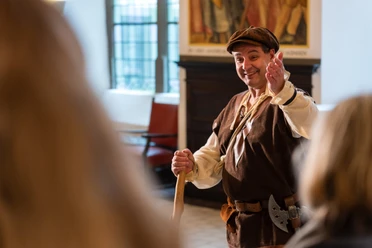
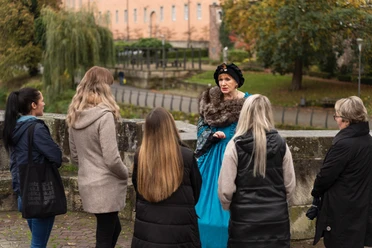
Dressed in traditional sailors’ attire, the two tour guides will share the history of the Schlagden and its significance for the city’s development. In addition, visitors can view a small photo exhibition at the Haus der Fischfreunde at Speckstraße 10.
C) The Hann. Münden Train Station Over the Past 175 Years
Start: 11:30 a.m. and 2:30 p.m.
Duration: approximately 45 minutes each
Guides: Thomas Tölle and Carl Jäger
Meeting point: Clubhouse of the Modellbauclub Münden e. V., Mitscherlichstraße 5A in the Forest Botanical Garden
Starting in the mid-19th century, the railroad fundamentally transformed the infrastructure of the German states. It enabled faster travel and more efficient transportation of goods.
Using historical images and photographs, the tour provides interesting insights into the development of the Hann. Münden train station over the past 175 years.
This tour is suitable for children ages five and up. The number of participants is limited to 18 to 20 people.
The walk from the meeting point to the train station is about 350 meters long and includes some uphill sections. In case of rain, parts of the path may be muddy and slippery.
Good to know
Eligibility
Bad Weather Offer
Suitable for any Weather
Target Group Teenager
Target Group Adult
Target Group the Elderly
for Groups
for individual guests
Foreign Language
- German
Price info
free of charge
free of chargeContact person
Stadtverwaltung Hann. Münden
Böttcherstraße 334346 Hann. MündenLicense (master data)
Hann. Münden Marketing GmbH